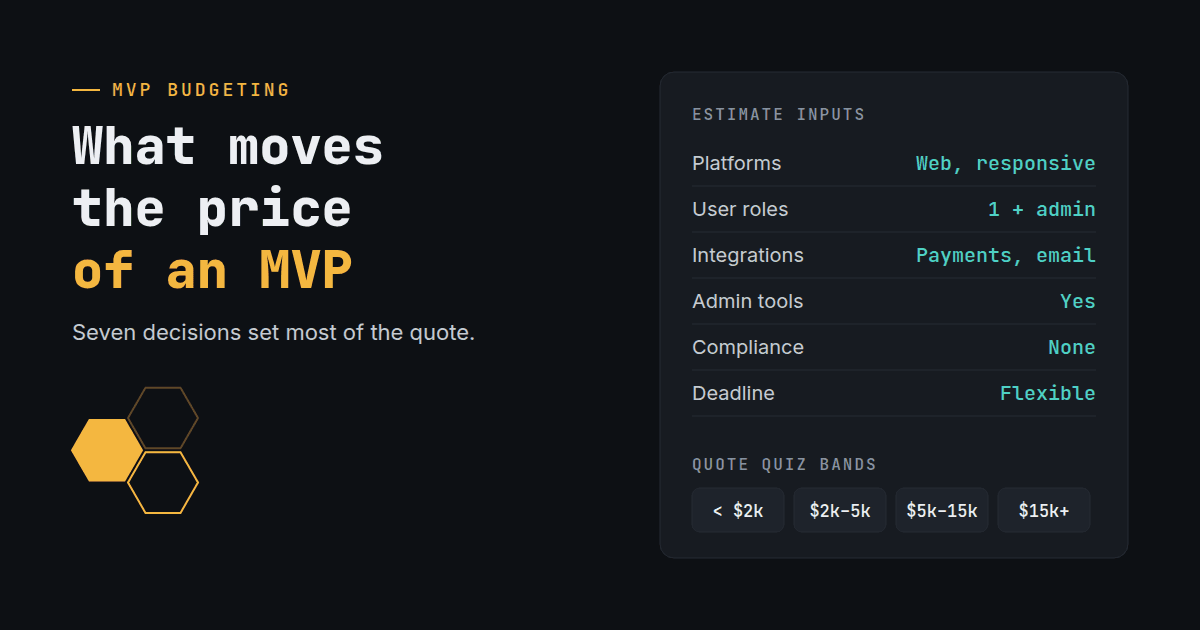
"How much does an MVP cost?" has an honest answer: it depends on six or seven decisions, and most of them are yours. Two founders can describe "an app like Uber for X" and get wildly different quotes, because one means a booking form with an admin screen and the other means live maps, payments, two mobile apps and a dispatcher dashboard.
This post walks through what actually moves the price of an MVP, which costs founders tend to forget, and how to cut the number without cutting what matters. It is written for founders getting their first quotes.
What an MVP is (and isn't)
An MVP is the smallest product that lets real users do the one job you are betting on, so you can learn whether they want it. It is not version 1.0 with fewer features, and it is not a prototype that only works in a demo.
That definition matters for cost. Every feature that doesn't serve the one job is money spent before you know whether the idea works.
What drives the cost of an MVP
These are the decisions that move a quote the most, roughly in order of impact.
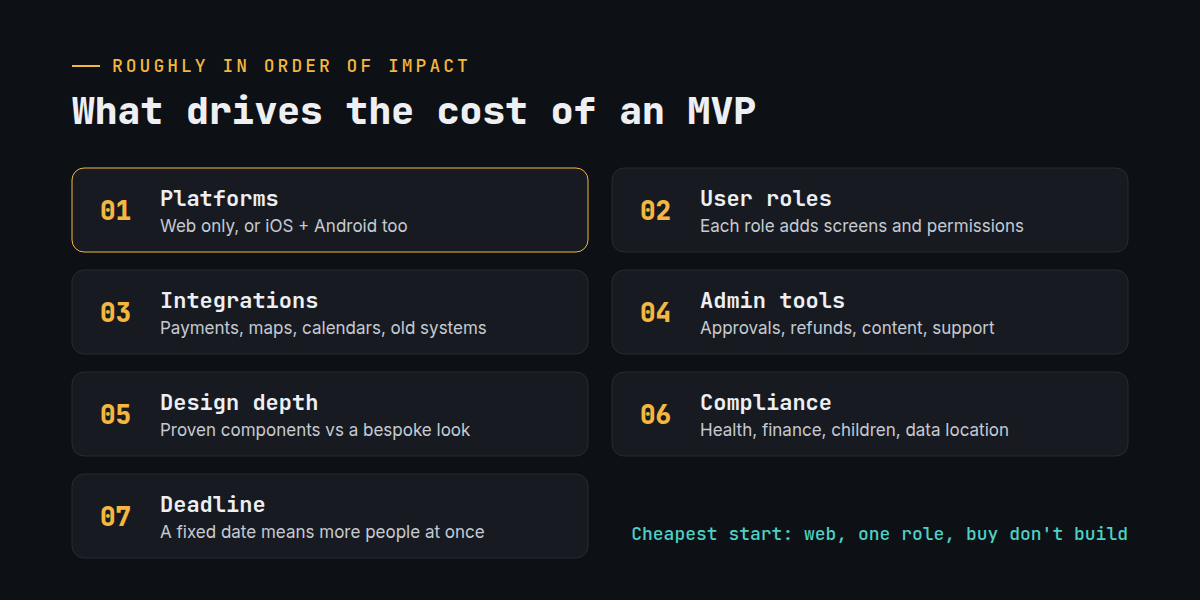
1. How many platforms
A responsive web app is one codebase that works on phones and desktops. Native iOS and Android apps add a second (and sometimes third) codebase, app store setup and review, and device testing. Cross-platform frameworks such as React Native or Flutter reduce, but don't remove, that extra work.
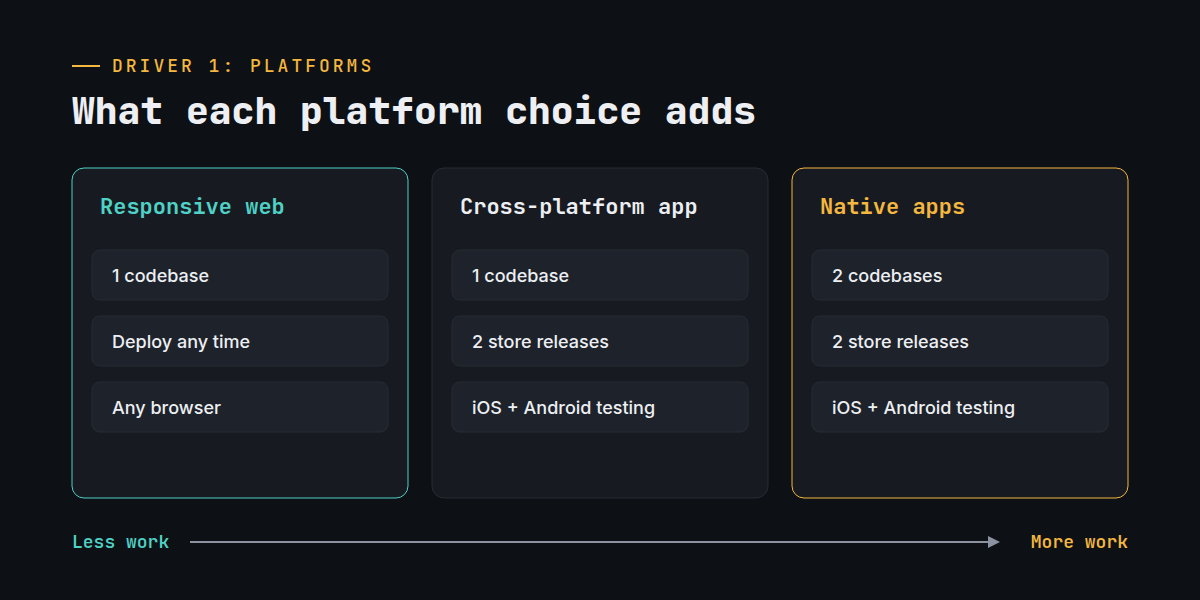
If your users can do the job in a browser, starting with the web is usually the cheapest way to learn. A follow-up post covers the web-or-mobile decision in depth.
2. How many kinds of user
Each role (customer, provider, admin, manager) needs its own screens, permissions and test cases. A marketplace with buyers, sellers and an operator is close to three products. One role is the cheapest MVP you can build.
3. Integrations
Payments, maps, calendars, email, SMS, accounting software, an existing database. Each one adds setup, edge cases and failure handling. Well-documented services such as Stripe are predictable. Older or poorly documented systems (some healthcare and enterprise software) can take longer than the feature they serve.
4. Admin and back-office tools
Someone has to approve accounts, issue refunds, edit content and answer support emails. Founders often forget this screen exists until launch week. A simple admin panel is a normal part of an MVP budget, not an extra.
5. Design depth
A clean interface built from a proven component set costs far less than a custom visual identity with bespoke illustrations and animation. For an MVP, clear and consistent beats distinctive. You can invest in brand once you know what users value.
6. Rules you can't skip
Health data, financial data, children's data and some regions bring legal requirements: access logs, encryption, data residency, consent records. These are not optional and they add real work. Say so at the start, not after the quote.
7. Deadline
A fixed date that leaves no room for scope to move usually means more people working in parallel, which costs more per feature. A flexible window lets the same work happen with less overhead.
The costs founders forget
The build is not the whole bill. Budget for these too:
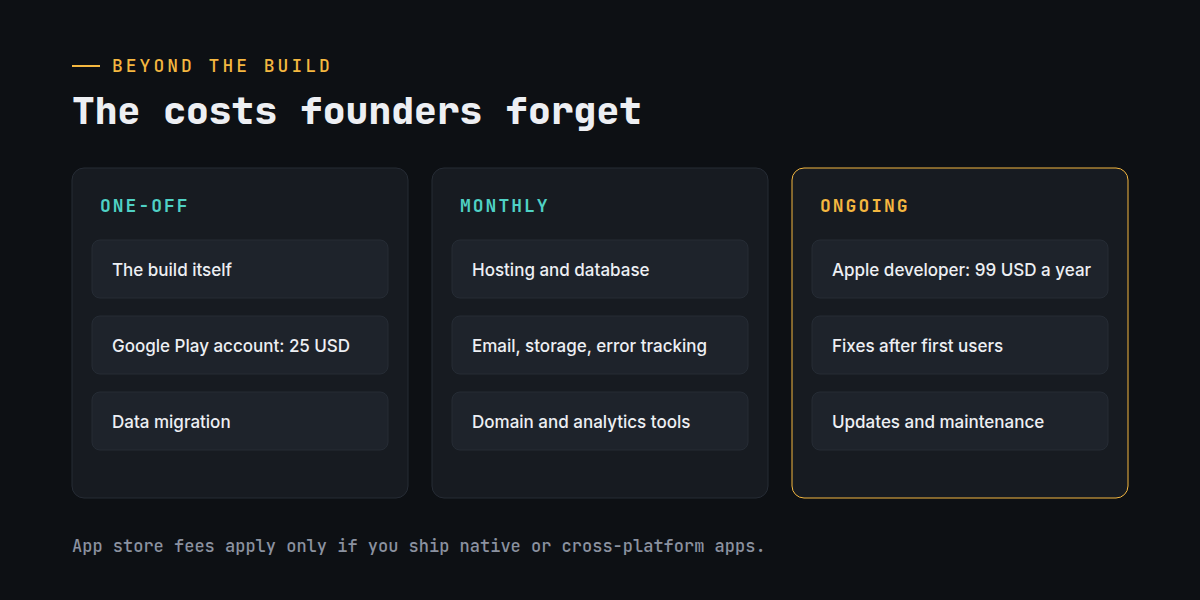
Hosting and services. Servers, database, file storage, email sending and error tracking. Small for an MVP, but monthly.
App store accounts if you go native. Apple charges 99 USD a year for its developer program and Google Play charges a one-time 25 USD registration fee.
Domain, email and analytics.
Changes after launch. The first real users always find something. Keep part of the budget for the weeks after go-live.
Maintenance. Dependencies, operating systems and third-party APIs change. Someone needs to keep the app working.
How to bring the price down without gutting the product
Pick one platform. Usually the web.
Pick one user role if the business allows it. Run the other side manually at first: you approve the providers, you send the invoices.
Buy, don't build. Use existing services for login, payments, email and search instead of writing them.
Write the brief before asking for quotes. Vague requests get padded quotes, because the developer has to price the unknowns. A one-page brief removes most of them.
Cut by flow, not by polish. Remove whole features you can live without, rather than shipping every feature half-finished.
Getting a number for your own idea
Our quote quiz asks five questions: what you need, the scope, how complex it is, the timeline, and what happens after launch. It then gives you one of four budget bands: under $2,000, $2,000 to $5,000, $5,000 to $15,000, or $15,000 and up. It takes about a minute and is a better starting point than any average price you'll find online, because it is based on your answers.
What to take from it
The price of an MVP is set by platforms, user roles, integrations, admin needs, design depth, compliance and deadline.
Building for the web first, and for one user role, is the fastest way to lower the number.
Budget for hosting, app store fees, post-launch fixes and maintenance, not just the build.
A clear one-page brief gets you tighter, more honest quotes.
Sources
If you want to talk scope with the engineer who would build it, get in touch.