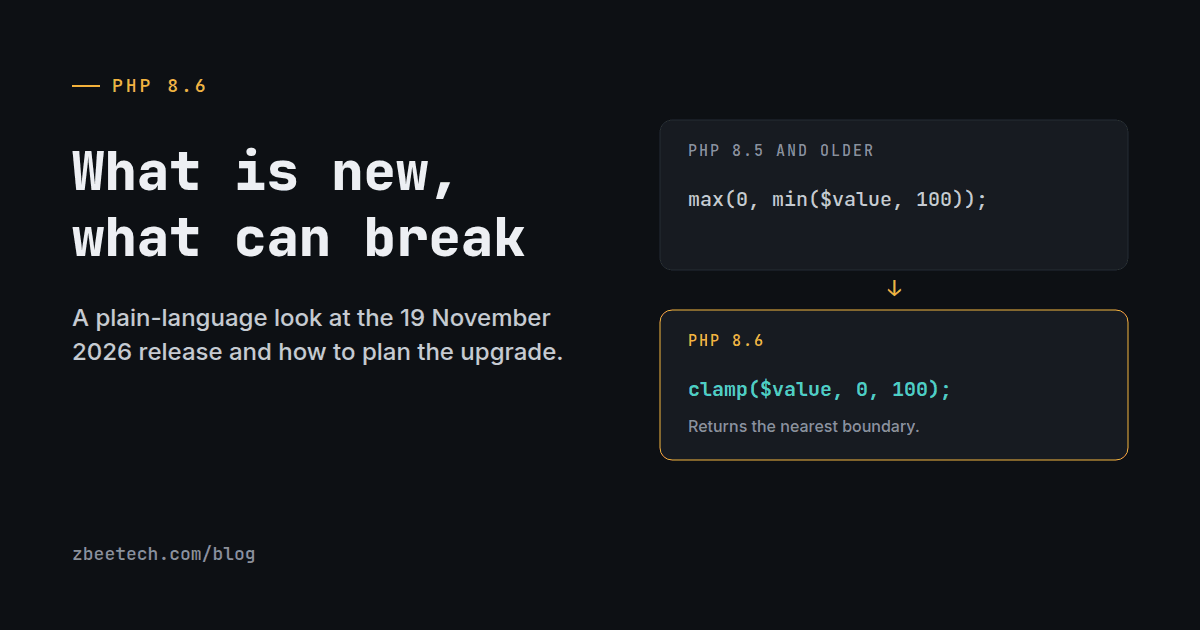
PHP 8.6 is scheduled for release on 19 November 2026. It adds a handful of features that make everyday code shorter and safer, and it deprecates a list of old functions that some codebases still use.
If you run a PHP application, none of this is an emergency. PHP 8.5 is still fully supported. But the new features show where the language is heading, and the deprecations are easier to deal with now than during a forced upgrade. This post covers what is new in PHP 8.6, what can break, and how to plan the move.
What is new in PHP 8.6
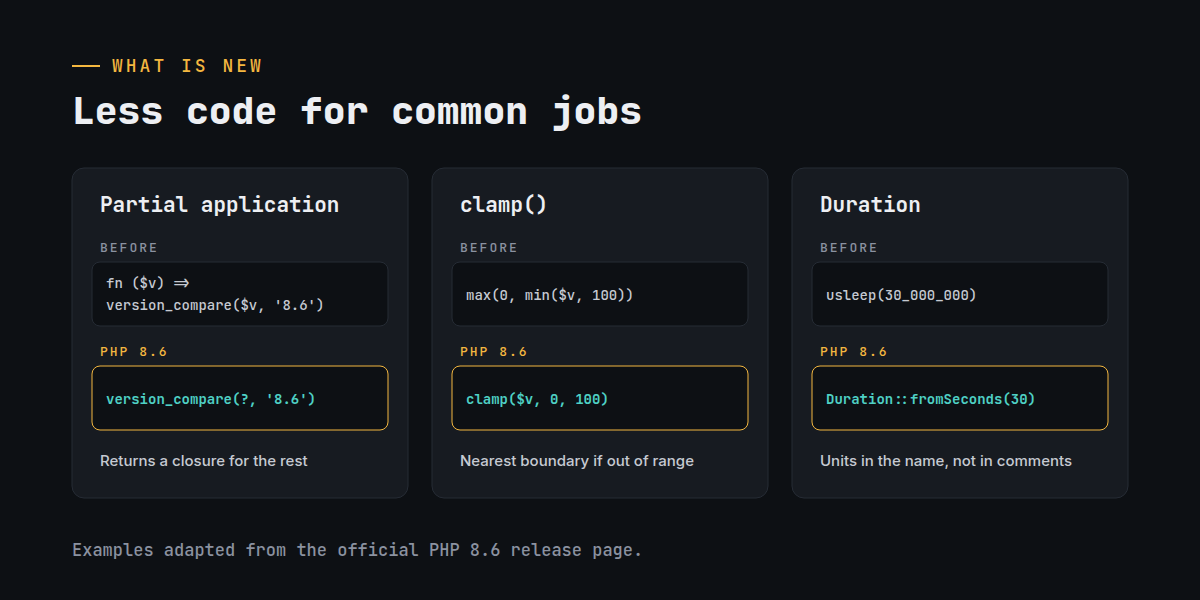
The headline changes, as listed on the official PHP 8.6 release page:
Partial function application. Give a function some of its arguments now and use
?for the rest. You get back a closure that takes the remaining arguments.version_compare(?, '8.6', '>=')replaces a small wrapper function.A
Durationclass.\Time\Durationrepresents elapsed time, such as a timeout or a retry delay, without tying it to a date or timezone. You can add, multiply and compare durations instead of passing around raw microsecond integers.A
clamp()function.clamp(110, 0, 100)returns100. It replaces themax(0, min($value, 100))pattern.A
SortDirectionenum. One built-in type for "ascending or descending", so libraries stop inventing their own integers and strings.A Polling API.
Io\Pollwatches many network connections at once using the fastest mechanism on each platform. It mostly matters to people who write event-loop libraries such as ReactPHP and AMPHP, and to long-running PHP services.Readonly property defaults. A readonly property can now have a default value, so you no longer need a constructor just to set a fixed one.
Better stream errors. File and network operations can throw a
StreamExceptionwith structured details instead of emitting a plain warning.
There are also smaller additions: post-quantum key encapsulation in the Sodium extension, TLS 1.3 early data, URI builder classes, and a mysqli::quote_string() method.
Most of these are conveniences. The change a typical web app is most likely to notice is not a feature at all. It is the stricter session defaults, covered below.
What can break when you upgrade PHP to 8.6
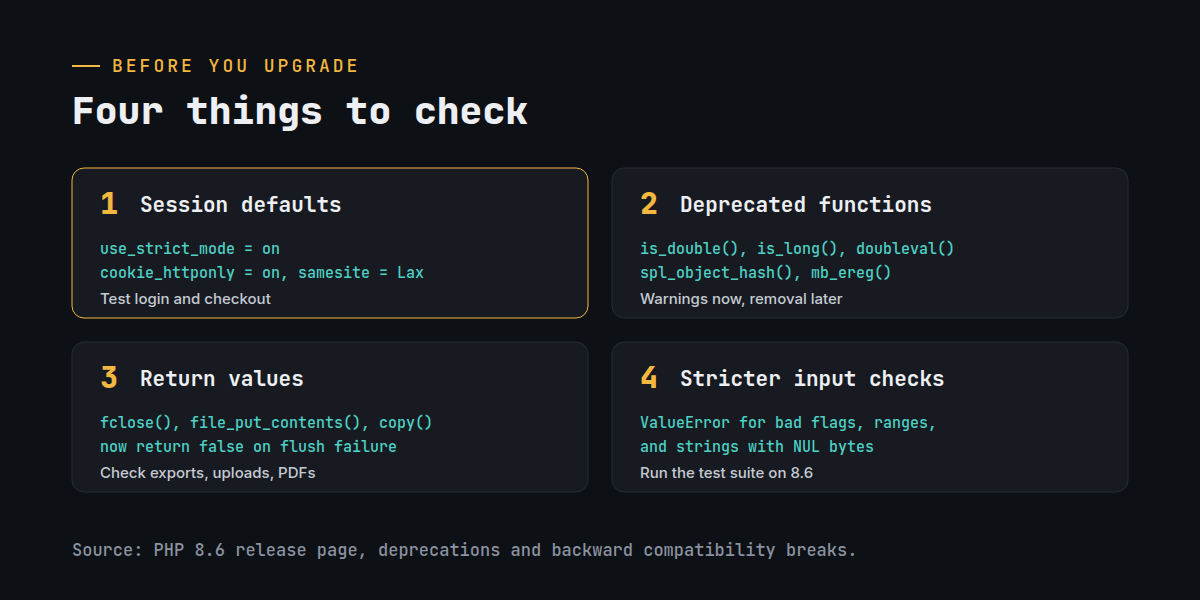
Deprecations are warnings, not errors. Your code keeps running, but your logs fill up and a later release will remove the feature. Behavior changes are the ones that can break something today. The PHP team lists both in the release notes.
Behavior changes to test:
Sessions are stricter by default.
session.use_strict_modeandsession.cookie_httponlyare now on, andsession.cookie_samesitedefaults toLax. If your app reads a session cookie from JavaScript, or relies on a cross-site POST that carries the session, test login and checkout.trim(),ltrim()andrtrim()strip form feed characters by default.fclose(),file_put_contents()andcopy()returnfalsewhen flushing or closing the stream fails. Before, the failure was ignored. Check any place where you assume the write worked, such as exports, uploads and invoice PDFs.Many functions throw a
ValueErrorfor out-of-range values, bad flags or strings containing NUL bytes, instead of quietly truncating them.
Deprecations to search your code for:
returninside afinallyblock.is_double(),is_long(),is_integer()anddoubleval(). Useis_float(),is_int()andfloatval().spl_object_hash(). Usespl_object_id().The mbstring regex functions such as
mb_ereg()andmb_split(), because the library under them is no longer maintained. Use PCRE functions with theumodifier.Using
letorisas a class, function or constant name.strcoll()and theSORT_LOCALE_STRINGflag.Passing a third argument to
define().
A plain text search for these names across your own code and your Composer packages takes minutes and tells you how much work there is.
Should you upgrade to PHP 8.6 now?
Not on day one, and not on production first. A new .0 release needs time for frameworks, CMS plugins and extensions to confirm support. Check that the framework and every Composer package you depend on lists PHP 8.6, then run your tests on it in CI before you touch a server.
The real deadline is your current version, not 8.6.
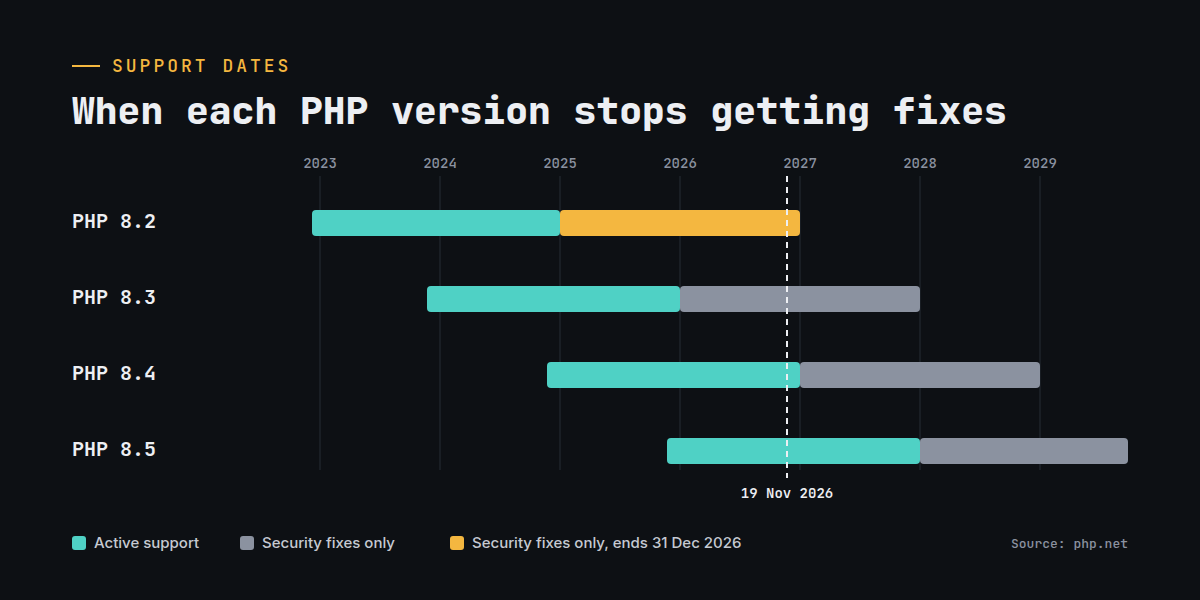
Each PHP branch gets two years of active support and two more years of security fixes only. As of 19 November 2026, according to php.net:
PHP versionActive support untilSecurity fixes until8.231 Dec 2024 (ended)31 Dec 20268.331 Dec 2025 (ended)31 Dec 20278.431 Dec 202631 Dec 20288.531 Dec 202731 Dec 2029
If you are on PHP 8.2, it stops receiving security fixes in about six weeks. Moving to 8.4 or 8.5 now is the safer first step, and it makes the later move to 8.6 smaller. If you are on 8.1 or older, you are already past end of life, and the priority is getting onto a supported version, not 8.6 specifically.
A practical upgrade plan
List what you run. PHP version, framework, CMS, and the Composer packages and extensions your app needs.
Run your tests on 8.6 in CI. Start with a copy of the current build and read the warnings it prints.
Fix deprecations in small commits. Most are one-line replacements.
Test sessions, uploads and payments by hand. These are the areas where the behavior changes bite.
Roll out to staging, then production, with a quick way back to the old version.
If your app has no automated tests, step 2 gives you nothing. In that case the first task is a small set of tests around the flows that earn money, before any upgrade.
What to take from it
PHP 8.6 adds partial function application,
Duration,clamp(), aSortDirectionenum and a Polling API.Deprecations only warn today. Stricter session defaults and file function return values are the changes most likely to affect a normal web app.
You do not need to move to 8.6 immediately. You do need to be on a supported version.
PHP 8.2 loses security support on 31 December 2026.
Sources
Checked on 19 November 2026.
If you want a second opinion on how big your own upgrade is, get in touch and you'll talk to the engineer who would do the work.