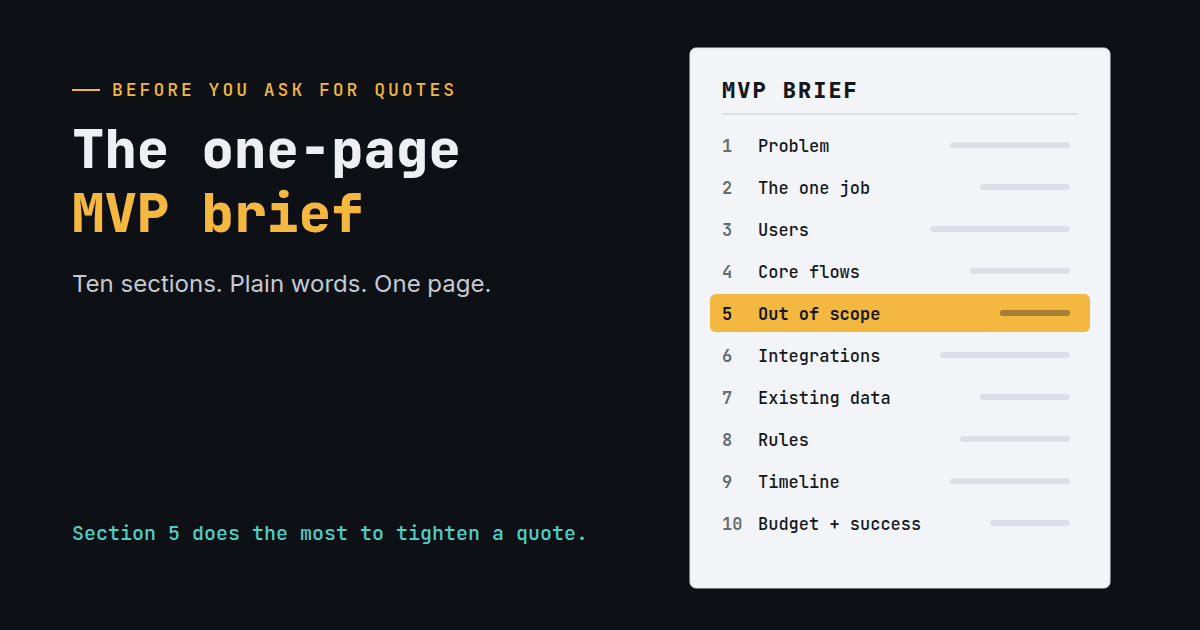
Before you ask anyone to quote your MVP, write one page about it. Not a 40-page specification, and not a pitch deck: a single page that tells a developer what the product must do, for whom, by when, and what it must not try to do yet.
A good MVP brief gets you faster replies, closer quotes from different studios, and a first call spent on real questions instead of guesswork. This post gives you the ten sections that belong in it and a template you can copy.
Why a brief changes the quote
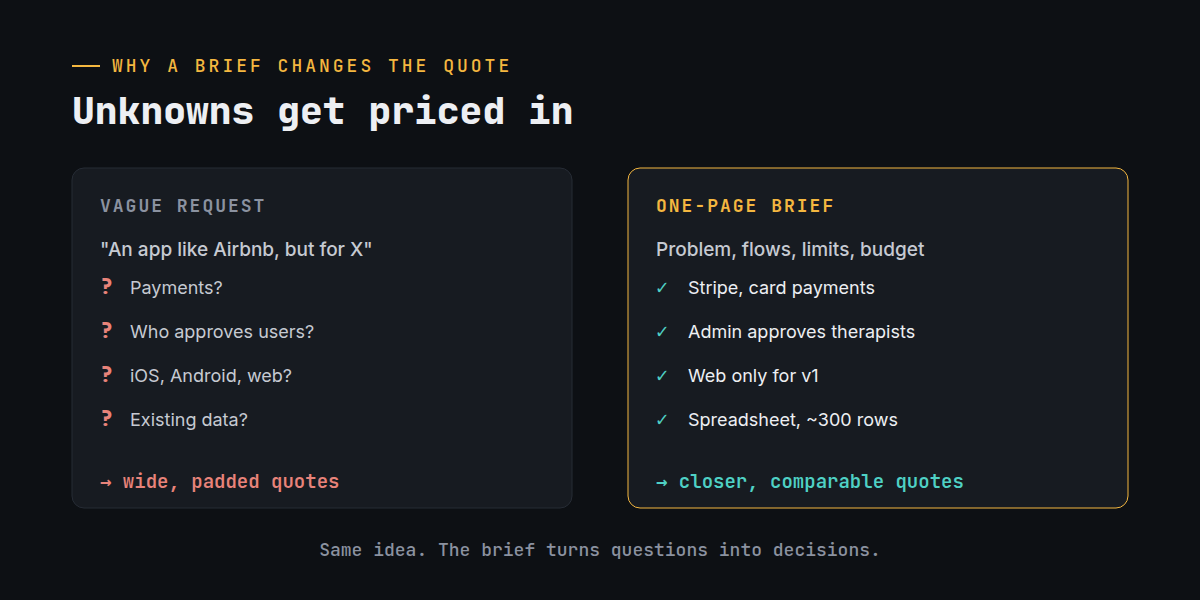
When a request is vague, a developer has two choices: ask a lot of questions, or price in the risk of not knowing. Most do some of both. Every unknown ("will there be payments?", "who approves new users?") either delays the quote or makes it bigger.
(For what moves the price, see what an MVP really costs.) A brief turns those unknowns into decisions. It also forces you to decide what the MVP is not, which is where most of the savings are.
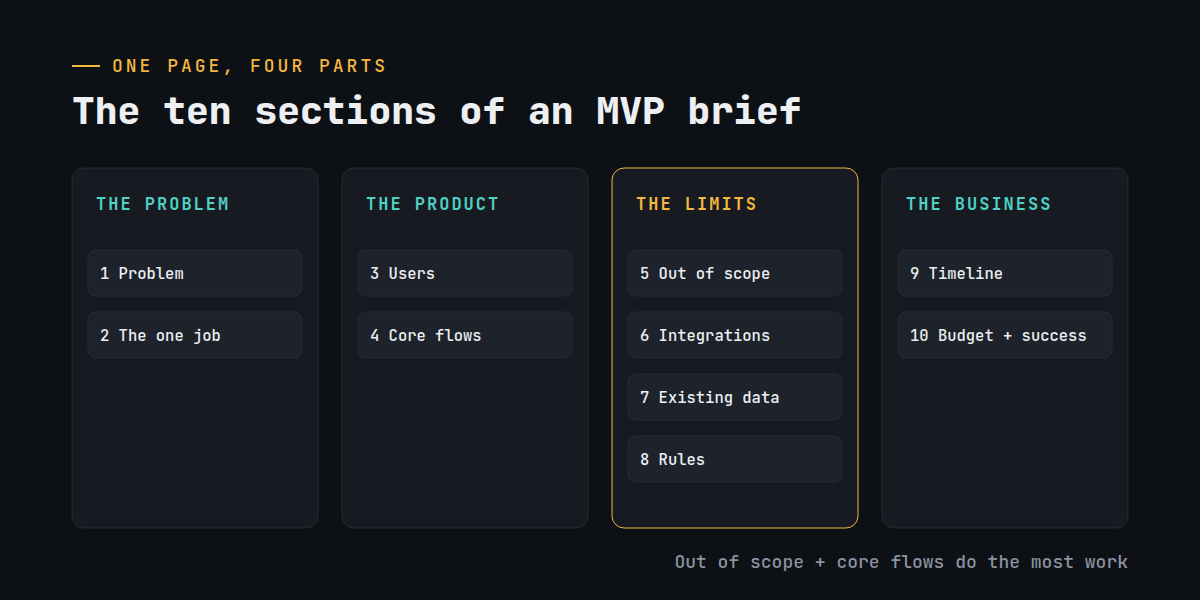
The ten sections of an MVP brief
1. The problem, in two sentences
Who has the problem, and what it costs them today. "Independent physiotherapists take every booking by phone, between patients" is useful. "Healthcare is broken" is not.
2. The one job of version 1
The single thing a user must be able to do for the MVP to count as working. If you have five, rank them and keep the top one or two.
3. Who uses it
List each kind of user (for example: patient, therapist, admin) and what each needs to do. Each role adds screens and permissions, so this list drives a lot of the cost.
4. The core flows, step by step
Write the three to five most important journeys as numbered steps, in plain words:
Patient opens the booking link.
Picks a free slot for the next two weeks.
Enters name, phone and reason.
Gets a confirmation by email.
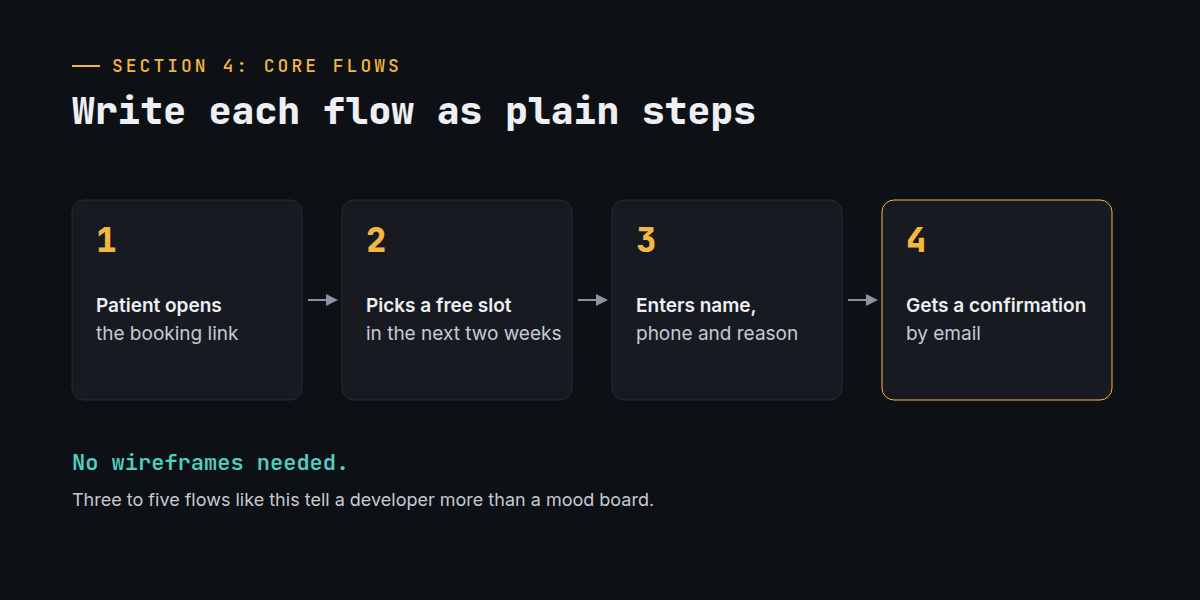
No wireframes needed. Clear steps tell a developer more than a mood board does.
5. What is out of scope
The most valuable section. Name the features you are deliberately leaving out of version 1: native apps, chat, reviews, multiple languages, a referral program. A developer can then quote what you asked for, not what you might mean.
6. Must-have integrations
Payments, calendars, email, an existing system you already pay for. Name the actual product (Stripe, Google Calendar, Mailchimp) if you know it.
7. Data you already have
Customer lists, a product catalogue, an old database or spreadsheet. Say what format it is in and roughly how many records, because migrating it is real work.
8. Rules that apply
Health data, payment card data, children's data, accessibility requirements, data that must stay in a certain country. If you aren't sure, write "not sure" rather than leaving it out.
9. Timeline, and why
The date and the reason for it: an investor meeting, a trade show, a season. A real reason helps a developer suggest what to cut if the date is tight.
10. Budget band and what success looks like
A range, even a rough one, saves everyone time. Then one or two measures that would tell you, 90 days after launch, that the MVP worked: "30 therapists booking through it weekly" is better than "users love it".
A template you can copy
MVP BRIEF: <product name>        Date: <today>

1. Problem
   <Who> struggles with <what>. Today it costs them <time/money/risk>.

2. The one job of v1
   A <user> can <do the core thing> without <today's workaround>.

3. Users and what they need
   - <Role>: <needs to…>
   - <Role>: <needs to…>

4. Core flows
   Flow A: 1. … 2. … 3. …
   Flow B: 1. … 2. … 3. …

5. Out of scope for v1
   - …
   - …

6. Integrations
   - <Service>: <what for>

7. Existing data
   - <What>, <format>, about <N> records

8. Rules that apply
   <Health / payments / children / region / accessibility / not sure>

9. Timeline
   Live by <date>, because <reason>.

10. Budget and success
    Budget band: <range>
    Success at 90 days: <measurable outcome>
Common mistakes
Describing the solution instead of the problem. "Build an app with a calendar" closes off cheaper options. Describe the job and let the developer propose how.
Skipping the out-of-scope list. Without it, every quote is for a different product.
Copying a big app. "Like Airbnb" describes years of work. Say which single part of it you need.
Hiding the budget. You don't have to share an exact figure, but a band lets a developer tell you what fits.
How to use the brief
Send the same brief to every studio or freelancer you are considering. Their replies become easy to compare: who asked good questions, who pushed back on scope, and who quoted something you didn't ask for.
If you don't have a budget band yet, our quote quiz asks five questions about scope, complexity, timeline and support, and gives you one in about a minute. Put it in section 10.
What to take from it
One page, ten sections, written in plain words.
The out-of-scope list and the core flows do the most to tighten a quote.
State the timeline with its reason and a budget band.
Send the same brief to everyone you are comparing.
If you'd like a second pair of eyes on your brief, send it over and you'll hear back from the engineer who would build it.